NEWSLETTER DETAILS
News Briefs (October 2026)
Our News Briefs bring you the latest highlights from the advocacy efforts of APRRN and our members, as well as keeping you informed on upcoming events and activities. We strive to provide regular updates on the network’s activities and developments in the refugee protection sphere, alongside the emerging political climate in the Asia Pacific region. We welcome contributions from members! Please share your updates, information, or resources with Ali at msco@aprrn.org
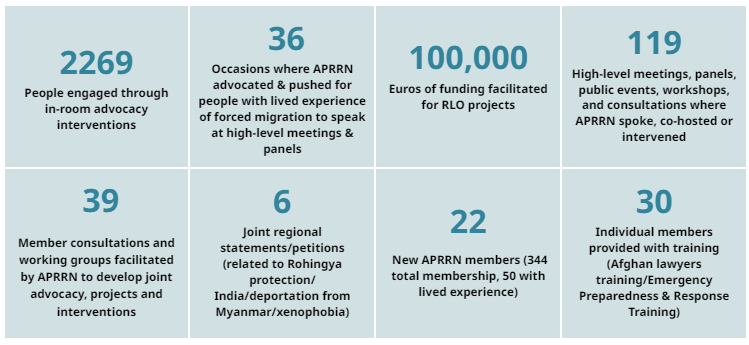
The year so far, in numbers: Jan - September 2026
Advancing Refugee Self-Reliance: Southeast Asia Regional Learning Exchange
From 28–30 October 2026, APRRN co-convened the Southeast Asia Regional Learning Exchange on Meaningful Economic Inclusion and Equitable Social Protection, alongside the Refugee Self-Reliance Initiative (RSRI), Asylum Access Thailand, Jesuit Refugee Service, and the Refugee-Led Research Hub. Held in Bangkok, Kuala Lumpur, and online, the exchange brought together nearly 60 leaders from community-based organisations across Southeast Asia to share experiences and identify practical approaches to refugee self-reliance amid declining humanitarian funding and evolving regional policies.
Over three days, participants explored barriers to economic inclusion, gaps in healthcare and education, and the conditions needed for sustainable self-reliance. Discussions highlighted the importance of accessible documentation, decent work, equitable social protection, long-term financing, and meaningful refugee participation in decision-making. The exchange concluded with community representatives presenting their priorities to government, UN, diplomatic, development, and academic stakeholders, reinforcing the need for shared responsibility and sustained collaboration to advance refugee inclusion across the region.
Voices from the Border: Speaker Series and Between Borders Report Launch
Settlement Services International (SSI), in partnership with APRRN and Amnesty International Australia, hosted the Voices from the Border Speaker Series in Parramatta, Australia, to launch the Between Borders report. The report draws on a joint field mission to Thailand and Bangladesh in June 2026, marking World Refugee Day and ten years of partnership between SSI and APRRN. The delegation engaged with refugees, refugee-led organisations, UN agencies and government representatives in Cox’s Bazar and along the Thai–Myanmar border, documenting protection challenges and emerging opportunities.
The report documents the worsening conditions facing refugees displaced from Myanmar and outlines recommendations for the Australian Government to strengthen protection, humanitarian assistance, expand pathways to safety and facilitate refugee-led solutions.
The event brought together representatives from SSI, APRRN, Amnesty International Australia, UNHCR and the Australian government, alongside powerful contributions from Rohingya women advocates and refugee-led organisations. Discussions highlighted the urgent need to sustain international attention on the Rohingya crisis, expand resettlement and complementary pathways, address humanitarian funding shortfalls, and strengthen partnerships with refugee-led and women-led organisations. APRRN Co-Secretaries General Klaus Dik Nielsen and Hafsar Tameesuddin contributed to the discussions, reinforcing the importance of refugee leadership in shaping regional protection responses. Read the full Between Borders report
Meeting at the Mexico Embassy in Thailand:
Invited by Atzimba Luna, Deputy Chief of Mission at the Mexico Embassy in Bangkok, Klaus brought Steering Committee (SC) Member Kunanyaporn Jiirasamatakij (Git), SC representative Tanyakorn Thippayapokin (Yves), and Thai Board Member Mic Chawaratt to discuss a number of issues and explore ways of collaboration between the diplomatic community in Bangkok and APRRN in advancing human rights for refugees and stateless persons in Thailand and the region.
2026 Annual Meetings of the IMF and the World Bank in Bangkok,
Between 12-16 October, Klaus attended a few sessions on collaboration between civil society and the WB/IMF, with a particular focus on social protection for vulnerable groups. During the event, the World Bank Group Philanthropy Hub was launched, and we are currently exploring ways to collaborate. Klaus also had a few meetings in the corridors, including with the new Country Director for the Danish Refugee Council in Afghanistan, Ajay Uprety.
APRRN facilitated and co-convened a closed-door discussion with Rohingya RLOs in response to Misinformation, Hate Speech, and Disinformation in collaboration with UNHCR and The Association for Progressive Communications (APC). The purpose of the meeting was to hear from RLOs regarding their responses to online MDH and how they mitigate and de-escalate them and create peer learning spaces for RLOs and civil society actors.
Q3 Board and Steering Committee Meetings
On 22 and 27 October, APRRN held its 3rd Board and Steering Committee meetings in 2026, during which the current financial health, challenges and opportunities were discussed, as was the leadership transition plan and the ongoing and future plans of the geographical and thematic working groups. A forthcoming membership guidelines document outline, which will be shared with members in November, was also discussed.
Member’s Spotlight!
Call for applications: Transformative Leadership in Action 2027
Applications are now open!
Are you ready to grow as a leader, learn across differences and turn collaboration into meaningful action?
Same Skies invites applications for the 2027 edition of Transformative Leadership in Action, a cross-sector leadership development programme bringing together people from diverse professional and cultural backgrounds to learn, exchange perspectives and collaborate with refugee-led organisations on real-world projects.
Through a combination of self-paced online learning, coaching, peer exchange and an immersive residential experience in Southeast Asia, participants will strengthen their leadership skills, explore new ways of working across differences and contribute to initiatives shaped by the priorities of refugee-led organisations.
No previous experience in the refugee or humanitarian sector is required – just curiosity, an openness to learn and a commitment to creating positive change.
Programme period: 11 January – 27 June 2027
Applications: Now open
Interested in taking part or sharing this opportunity with your network?

Explore the programme and apply
For enquiries about applications, partnerships, or opportunities to support the programme as an impact investor, please contact Same Skies: connect@sameskies.org

NANCEN, a refugee rights organization based in South Korea, produced a video on the current situation of refugees and key issues in refugee law in South Korea. The video examines the trends and limitations of the South Korean government's refugee protection policies, as well as key concerns regarding regressive amendments to the Refugee Act. The production of this video was supported by the Heinrich Böll Foundation's East Asia Regional Office. We hope this exchange will serve as an opportunity to share more experiences of refugee protection and stories of change from across Asia.
YouTube link: The Current Status of Refugee Rights in Korea and Key Issues in the Revision of the Refugee Act
Lawyer and advocate Mariam Veiszadeh warned of 'trickle-down racism' and the consequences in everyday Australian life when politicians scapegoat migrants and refugees. She was delivering the 2026 Kaldor Centre Oration.
More migrant women are in jobs they are overqualified for compared to male counterparts, research shows. Research conducted by Settlement Services International (SSI) shows that ‘about 340,000 migrant women working in Australia were employed below their skill level’. The report found migrant women ‘20 per cent more likely than their male counterparts to be over-qualified in their jobs’. Unable to get their overseas qualifications recognised in Australia, many migrant women are forced into ‘survival jobs’, SSI reported.
Consultations Highlight Challenges and Opportunities for Refugee Communities and Service Providers in Western Australia. UNHCR held consultations in Perth, jointly hosted by Multicultural Services Centre of Western Australia and the Refugee Council of Australia, exploring the realities of refugee settlement in Western Australia. Community leaders, people with lived experience, frontline service providers and advocacy organisations shared the complexity of the settlement process, including the emotional toll of family separation, the growing impact of social media-driven bullying and incidents of racial discrimination and violence.
As of the Blossom Future - Human Rights Program report in October 2026, civilian casualties, including mass fatalities, continued to occur as a result of military airstrikes, arson and destruction during military offensives, and arbitrary arrests. Particularly vulnerable groups, including children, students, and internally displaced persons, continued to suffer the severe consequences of these violations. At the same time, damage to and destruction of civilian infrastructure, including shops, residential houses, schools, clinics, and monasteries, continued to increase, forcing thousands of people to flee their homes. Furthermore, the continued occurrence of torture, enforced disappearance, and forced military recruitment has further exacerbated the human rights situation in Myanmar. In light of these developments, effective measures and targeted sanctions against the Myanmar military's airstrikes should be imposed to help halt these violations. Greater priority must also be given to civilian protection, alongside an expansion of humanitarian assistance to address the growing needs of affected populations. These measures are urgently needed to prevent further violations and alleviate the worsening humanitarian and human rights situation in the country.
Written by Husson Ahmad, APRRN’s Southeast Asia Working Group Deputy Chair, Repatriation Without Guarantees Is Not a Durable Solution for the Rohingya. For decades, the Rohingya people have endured persecution, displacement, and the denial of fundamental rights. Thousands have fled Myanmar in search of safety, while many others remain displaced within the country or live in refugee camps and host communities across the region. Yet despite years of diplomatic discussions, humanitarian interventions, and international commitments, one fundamental question remains unanswered: when will Rohingya people be able to live safely, freely, and with dignity in their homeland?
Written by Dafer Sief, APRRN member: Managed, but not heard: Barriers to refugee-led advocacy in Malaysia.
News from the region
Afghanistan:
Acute hunger at record levels, with 15.9M people facing acute food insecurity, per a global hunger monitor report. (UN News)
Afghanistan to face sharp rise in acute malnutrition in 2027, with over 4 million children projected to be in need of urgent treatment. Of these, more than 1 million children are expected to suffer from the most severe form of malnutrition.
Afghan women and girls are being arrested, detained and threatened with arrest by Taliban authorities, the UN warned on Thursday, as record numbers of returnees struggle to rebuild their lives in Afghanistan. (UN News)
Humanitarian organisations requested USD 12.8 million to provide winter assistance to vulnerable people across Afghanistan, emphasising the increasing support needs of returned refugees, saying many returnees are living in ‘inadequate and undignified conditions’ and are at risk of being displaced again. Meanwhile, Amnesty International published a new report highlighting the plight of half a million people displaced by conflict in Afghanistan, including internally displaced persons and returned refugees, who are subsisting in makeshift shelters in slum communities.
Australia:
Kaldor Centre published the Australian toolkit on international protection in the context of climate change and disasters.
Home Affairs 'unlawfully' jailed Australian citizen for 945 days, ombudsman reports. The Commonwealth Ombudsman reported that 30 people were unlawfully held in immigration detention in the past year, including an Australian citizen. Eighteen of them were unlawfully detained for one day because of a delay in communicating a ministerial visa approval to the department.
Interned as ‘enemy aliens’ in Australia, these WWII refugees built their own universities. A new podcast series explores the history of refugee-led universities set up in Australia’s internment camps during WWII. The podcast traces the stories of ‘European refugees who escaped Nazi persecution only to confront new forms of exclusion through Australia’s legal and bureaucratic systems’. Katherine Biber, Professor of Law at the University of Technology Sydney, explains how these bureaucratic systems have continued to deny refugees access to education in Australia.
Bangladesh:
In Cox’s Bazar, refugee women are building infrastructure and resilience for the community.
Bangladesh Prime Minister Tarique Rahman’s ‘5-Point’ Rohingya plan. Prime Minister Tarique Rahman’s plan offers the Rohingya two futures – indefinite warehousing at someone else’s expense, or return to a country that still refuses to call them citizens.
India:
Kashmir Chief Minister Omar Abdullah questioned the Indian government’s sudden action against Rohingya refugees living in the region, saying they were being targeted despite having fled persecution in Myanmar. He stated that Rohingya families had been provided shelter in India until conditions in their country of origin improved and described the recent eviction measures as unnecessary and unexpected. Abdullah distinguished the Rohingya situation from that of alleged Bangladeshi nationals who entered India without permission. He also said that the Jammu and Kashmir government had limited control over the action being taken against Rohingya refugees, placing responsibility at the central government level. His remarks have brought renewed attention to the protection of Rohingya refugees in Jammu and the need to address their displacement, shelter, and safety concerns.
The UN human rights office (OHCHR) has voiced concern over reports of mass detentions in India of demonstrators, protest leaders, civil society members, lawyers and journalists, before and during large-scale protests in Delhi on Saturday. (UN News)
Women of Change: Young refugees leading change in India.
Malaysia:
Malaysia has repatriated nearly 1,500 Myanmar nationals to Myanmar, a country still experiencing armed conflict and a severe humanitarian crisis. The returnees arrived by three Myanmar Navy ships on 4 October 2026 under a repatriation programme that could eventually involve 5,000 people. The United Nations and human rights organisations have raised concerns about the safety of those returned and whether their decisions to return were genuinely voluntary. There are also concerns that Rohingya refugees may be among the returnees, although their numbers have not been confirmed. Human rights advocates stress that returns must comply with the principle of non-refoulement, which prohibits sending people to places where they face persecution, torture, or other serious harm.
The Armed Conflict Location & Event Data (ACLED) analysis examines why Malaysia is repatriating thousands of Myanmar nationals despite the country’s ongoing civil war. According to ACLED analyst Sindy Ajara, growing anti-refugee sentiment, public pressure, and domestic political considerations have contributed to the Malaysian government’s decision to return up to 5,000 Myanmar nationals. The first group of nearly 1,500 people was repatriated on 29 September 2026, while the safety of those returned remains a major concern. Rohingya refugees face particular risks because of their statelessness, lack of citizenship rights, ongoing persecution, and potential forced military recruitment in Myanmar. ACLED warns that further repatriations without addressing the conflict and ensuring effective protection could expose vulnerable refugees to serious harm and encourage other host countries, including India, Bangladesh, and Thailand, to adopt similar policies.
Malaysia has shifted from its earlier expressions of solidarity with Rohingya refugees to closer engagement with Myanmar’s military-backed leadership, as it moves forward with plans to repatriate thousands of Myanmar nationals. Prime Minister Anwar Ibrahim has hosted Myanmar leader Min Aung Hlaing amid efforts to secure Myanmar’s cooperation in accepting returnees, including discussions linked to Rohingya repatriation. Malaysia says the returns are voluntary, but the United Nations and human rights organisations have raised concerns about the safety of people sent back to a country affected by ongoing civil war and persecution. Rohingya refugees face particular risks because of their statelessness and longstanding persecution in Myanmar. The developments have raised concerns among rights advocates that diplomatic and domestic political considerations could take precedence over refugee protection and the principle of non-refoulement.
Malaysian police have arrested two more local men in connection with a Molotov cocktail attack on a Rohingya settlement in Kulai, Johor, bringing the total number of suspects arrested to 15. The attack occurred on 13 October 2026, when Molotov cocktails were thrown at homes in the settlement, causing a minor fire but reportedly no injuries. The two latest suspects, aged 27 and 28, were detained to assist with the investigation, and one reportedly has a history of criminal and drug-related offences. Police have completed the investigation papers and referred them to prosecutors for further action. Four suspects are expected to face charges under Section 436 of Malaysia’s Penal Code, while the remaining 11 have been released on police bail.
Gina Romero, UN Special Rapporteur on the Rights to Freedom of Peaceful Assembly and of Association, on Linkedin and Twitter (X).
Crackdown on Freedom of Expression and Human Rights Defenders in Malaysia.
Open Letter: Drop charges against Rohingya human rights defender in Malaysia.
Rohingya Rights Advocate Faces Charges Over Unregistered Organization in Malaysia.
Human rights defender Zafar Ahmad Abdul Ghani charged over unregistered organisation.
South China Morning Post (YouTube, with reflections from Nur Sadek), How online hate triggers real-world violence in Malaysia.
Cops nab 13 over Molotov attack on Myanmar refugee settlement. Police have detained 13 Malaysians following a Molotov cocktail attack targeting several homes at a Myanmar refugee settlement in Kulai Besar, Kulai, Johor, on Oct 13 … four of the suspects had records involving 12 criminal and drug offences. … Four of the suspects were remanded for eight days, and another four for a week from Oct 14. One suspect was remanded for five days from Oct 15, while four others were remanded for a week from today.
Refugees’ worst fears realised as Myanmar junta detains hundreds deported by Malaysia. More than 400 ethnic Rakhine deported from Malaysia have been placed under military custody by the Myanmar regime, confirming the worst fears expressed by rights groups over Prime Minister Anwar Ibrahim’s deal with the repressive junta to send back thousands of refugees and Rohingya amid a xenophobic campaign targeting migrants.
Well-Being and Labor Market Outcomes of Refugees in Malaysia: Insights from the HARMONY Survey. The report examines the socioeconomic conditions of refugees and asylum seekers in Malaysia. Despite being allowed to remain in the country on humanitarian grounds, refugees face significant challenges due to the absence of a formal refugee policy, including restricted access to legal employment, education, social protection, and financial services. The report highlights ongoing policy discussions regarding refugees’ right to work and the potential contribution of refugees to addressing labor market needs.
Myanmar:
UN Special Envoy on Myanmar Julie Bishop visited Dhaka, Bangladesh, on 19 October 2026 and met with Home Minister Salahuddin Ahmed to discuss the Rohingya refugee crisis and repatriation. The discussions focused on Myanmar’s deteriorating political and security situation, the escalating humanitarian crisis, and security challenges along the Bangladesh-Myanmar border. Bangladesh highlighted the pressure of hosting approximately 1.2 million Rohingya refugees and called for stronger international support to achieve a lasting solution. Bishop outlined her diplomatic efforts to help end the armed conflict between the Myanmar military and the Arakan Army and establish effective civilian protection mechanisms in Rakhine State. Both sides stressed the importance of addressing regional security threats, including landmines, human trafficking, and drug smuggling, while pursuing the safe, voluntary, and dignified repatriation of Rohingya refugees.
Myanmar leader Min Aung Hlaing made an official visit to the country on Aug. 6. Days after the visit, Thai authorities raided an undocumented Karen community in Kaeng Krachan National Park, arresting 28 villagers, including children and pregnant women, and slated 26 people for deportation to Myanmar. Thailand has also enacted a new law authorising the swift deportation of foreign nationals who violate domestic regulations – a measure human rights activists warn will leave refugees more vulnerable to forced repatriation.
Naoero and Manus Island:
Government pulls out of ICC while new refugee agreement with Australia made public. CIVICUS, a global network that monitors civic participation, has rated the civic space in Naoero as ‘obstructed’. This comes after President David Adeang announced Naoero’s withdrawal from the International Criminal Court, and after details of the NZYQ deal with Australia were released to the public in September 2026.
Other news:
The United Nations has rushed to assist Nepal following new flash floods in the central Gorkha district on Sunday that swept away homes and bridges, just weeks after catastrophic flooding in the north. (UN News)
The Republic of Korea has contributed USD 5 million to the World Food Programme (WFP) to support Rohingya refugees in Bangladesh. The funding will provide life-saving food assistance, nutrition services, and school meals over a 12-month period. Approximately 164,000 vulnerable refugees will receive food assistance, while 36,000 pregnant and breastfeeding women will benefit from nutrition support. The contribution will also help provide school meals to 260,000 children attending learning centres. As nearly 1.2 million Rohingya refugees in Cox’s Bazar and Bhasan Char continue to depend on humanitarian aid, sustained international support remains essential to address hunger and malnutrition.
Cambodia’s government said that more than 20,000 Cambodians remain displaced due to a border conflict with Thailand, out of an estimated total of about 650,000 people displaced at the peak of the fighting in December 2025. At a UNHCR Executive Committee Session, Cambodia accused Thai forces of continuing to occupy parts of Cambodian territory, despite an ongoing ceasefire, preventing residents from returning home.
Wang calls for peace, development and cooperation to tackle refugee crises. China stands ready to work more closely with the Office of the United Nations High Commissioner for Refugees and make greater contributions to international humanitarian efforts.
Remarks of the Assistant High Commissioner for Protection, Edem Wosornu - 77th Executive Committee
NGO statements:
- NGO statement (International Institute for Human Rights, Environment and Development – INHURED) - watch at 2:25:00 here
- NGO statement on International Protection (CALOS & Oxfam)
Country Statements:
- Pakistan, on behalf of the Organisation of Islamic Cooperation (OIC)
- Thailand
- Islamic Republic of Iran
- Australia, on behalf of the Group of Friends for the Protection of Humanitarian Personnel
- Australia, on behalf of MIKTA (Mexico, Indonesia, Republic of Korea, Türkiye, Australia)
- Republic of Korea
- New Zealand
- Philippines
- Australia
- Indonesia
- Japan
- Turkmenistan
- Cambodia
- Myanmar (56:16), blaming the displacement of “Bengalis” on the ARSA attack in October 2016.
U.S. Statement at the 77th Session of the UNHCR Executive Committee delivered by Adam Zerbinopoulos (previously based in Bangkok), Senior Bureau Official, Bureau of PRM.
A UN Office on Drugs and Crime report estimated that in 2025, about USD 500 million was paid to migrant smugglers to access four main sea routes to Europe: the Eastern, Western and Central Mediterranean routes and the Atlantic route. The report said the majority (54%) of people smuggled on sea routes to Europe paid less than USD 5,000, with payments mostly made in cash to smugglers.
The International Organization for Migration (IOM) said at least 4,414 children died on migration routes worldwide between 2014 and 2025, and warned the actual number of child migrant deaths is likely to be far higher than the reported figure. IOM said its Missing Migrants Project recorded almost 81,000 migrant deaths and disappearances worldwide from 2014 to 2025, of which 55.5% of cases contain no information on the age of the migrants concerned.
Six non-profit legal services providers sued the Trump administration over a new policy to ‘fast-track’ unaccompanied child migrants’ asylum cases, which they claim undermines the rights of migrant children and puts them at greater risk of deportation. The organisations said the administration has ordered immigration judges to close all detained children’s cases by 31 January 2027 and is scheduling hundreds of asylum interviews at short notice periods – in some cases less than 24 hours – meaning lawyers have insufficient preparation time to effectively represent the children.
Cambodia’s government said that more than 20,000 Cambodians remain displaced due to a border conflict with Thailand, out of an estimated total of about 650,000 people displaced at the peak of the fighting in December 2025. At a UNHCR Executive Committee Session, Cambodia accused Thai forces of continuing to occupy parts of Cambodian territory, despite an ongoing ceasefire, preventing residents from returning home.
Reports & Publications
UPR submission on Papua New Guinea
Papua New Guinea is not a party to either the 1954 Convention relating to the Status of Stateless Persons or the 1961 Convention on the Reduction of Statelessness. No official data is available on stateless people in the country. Papua New Guinea lacks a statelessness determination procedure (SDP).18 According to UNICEF, only 13% of children are registered at birth in Papua New Guinea, which increases the risk of statelessness.19 However, the Australian Government and UNICEF are working to strengthen civil registration, and birth registration is being integrated into maternity services.20 In the 1st UPR cycle, UNHCR submitted that Papua New Guinea ought to give automatic citizenship to children born to a refugee parent, if they would otherwise be stateless and to reduce or waive the citizenship fee for those who had been in the country for more than 5 years.21 Concerns have also been raised regarding the potential statelessness of West Papuan refugees who have lost their citizenship due to absence from Indonesia and have not been granted PNG citizenship.
Proposed recommendations:
1. Continue efforts to improve birth registration, including for the children of refugees and stateless people and those living in rural areas;
2. Introduce legislation to ensure children born in PNG who would otherwise be stateless are granted citizenship, and to simplify the process for stateless refugees seeking naturalisation;
3. Accede to both the 1954 Convention and the 1961 Convention and take all steps necessary to implement them.
Lorraine Finlay, ‘The heartbreaking reality for women trapped in immigration detention’.
Mariam Veiszadeh, ‘The human cost of Australia’s migration debate’.
Karl Hoerr, ‘How climate change and disasters can apply to international protection claims’.

UN Special Rapporteur on the rights to freedom of peaceful assembly and association - Call for input into Research that supports 2027 Reports: to the Human Rights Council and the UN General Assembly … 1) Transnational repression, 2) People on the Move - guaranteeing freedoms of peaceful assembly and association without discrimination
Deadline: 30 November 2026
7 - 8 December, UNHCR: High Commissioner’s Dialogue on Protection and Solutions 2026,
The consultations will bring together States, refugee-led organizations, civil society, development actors, the private sector, host communities, and other relevant stakeholders... and will focus on strengthening implementation across protection and solutions frameworks.

Shadowing Programme for Young Theatre Professionals from Abroad
Grant Size: $1000 to $10,000
Countries/Regions: Afghanistan, Australia, Bangladesh, Bhutan, Cambodia, Hong Kong India, Indonesia, Iran, Iraq, Ireland, Japan, Kazakhstan, South Korea, North Korea, Kyrgyzstan, Laos, Malaysia, Maldives, Mongolia, Myanmar, Namibia, Nauru, Nepal, New Zealand, Pakistan, Papua New Guinea, Singapore, Sri Lanka, Taiwan, Tajikistan, Thailand, East Timor (Timor-Leste), Uzbekistan, Vanuatu, Vietnam,
The Shadowing Programme has launched its applications to support international artists within the field of Performing Arts an internship for a stay in Germany at a theatre or production house.
Deadline: Dec 31, 2026
Reckitt Catalyst Accelerator Program 2026-2027
seeks to support women and underrepresented founders developing innovative solutions that improve access to health and water, sanitation and hygiene (WASH) services in India. Countries/Regions: India, Indonesia, Pakistan
Deadline: Dec 31, 2026
TFD's International Grants Program
Grant Size: $10,000 to $100,000
Area: Capacity Building, Democracy & Good Governance, Human Rights, Research
Applications are open for the Taiwan Foundation for Democracy International Grants Program, inviting international non-profit organizations, academic institutions, and think tanks to submit project proposals that advance democracy and human rights worldwide.
Deadline: Dec 15, 2026
The Migration Partnership Facility (MPF) Call for Proposals 2026 supports projects that strengthen cooperation between EU Member States and partner countries to advance the external dimension of the European Union’s migration policy. Applications are received on a rolling basis until depletion of funds Financial envelope: 6,000,000 EUR Funding sources: Asylum, Migration and Integration Fund (AMIF).
NED Grants Program – National Endowment for Democracy
Global — over 100 countries on Democracy, human rights, freedom of press, civil society, rule of law, civic education - September 21, 2026, January 27, 2027, June 28, 2027
Open to nongovernmental organizations — civic groups, associations, independent media, and CSOs — working in countries with nascent democracies, transitional, semi-authoritarian, or highly repressive contexts. No funding for individuals, governments, or public institutions. Apply by email to the regional address corresponding to your project location.
Submit Applications for PFH's India Fund
Grant Size: $10,000 to $100,000
Countries/Regions: India
Area: Community Development, Disability, Education, Health, Leadership, Poverty Alleviation, Women & Gender
The India Fund is inviting applications from local Indian NGOs working with vulnerable communities in priority regions to support community-led development and systemic change.
Deadline: Dec 31, 2026
Human Rights Defenders (HRD) Protection Resources links to resources for HRD at risk by the Special Rapporteur on HRD.
Kim Wall Memorial Fund 2026-27
Grant Size: $1000 to $10,000
Area: Individuals, Journalists, Journalism, Media, Women & Gender
The Kim Wall Memorial Fund seeks applications to support women and nonbinary journalists pursuing stories about subcultures and the undercurrents of rebellion in the spirit of Kim Wall’s adventurous, globally minded reporting.
Deadline: Dec 06, 2026
Open Call for UNIV’R Scholarship at Sciences Po Paris
Area: Individuals, Refugee & Asylum Seekers
The UNIV’R scholarship is currently accepting applications to provide fully funded master’s study in France for refugees residing in their first country of asylum outside the European Union.
Deadline: Jan 31, 2027
Call for Proposals for Climate Security in the Philippines
Donor: Women’s Peace & Humanitarian Fund
Grant Size: $100,000 to $500,000
Area: Climate Change, Humanitarian Relief, Leadership, Peace & Conflict Resolution, Sustainable Development, Women & Gender
The Climate Security Call for Proposals from the Women’s Peace & Humanitarian Fund provides grants to local women-led, young women-led, women’s rights, youth rights, feminist, and civil society organizations in the Philippines to advance women’s leadership in climate security, humanitarian response, peacebuilding, and climate justice.
Deadline: Dec 31, 2026
Rafto Prize for Nonviolent Human Rights Advocacy
Area: Human Rights, Individuals
The Rafto Prize from the Rafto Foundation recognizes individuals and organizations whose nonviolent work advances the ideals and principles of the United Nations Universal Declaration of Human Rights through an annual human rights prize.
Deadline: Feb 01, 2027
AOYF Human Rights Photography Prize
Grant Size: $10,000 to $100,000
Area: Arts & Culture, Visual Arts, Human Rights, Artists
The AOYF Human Rights Photography Prize, offered by the Act On Your Future Foundation, invites artists working with photography and contemporary image practices to develop work around human-rights issues, with its international edition examining post-truth, images, and how reality is represented.
Deadline: Dec 20, 2026
Open Call for Courage in Journalism Awards
Area: Journalists, Women and Girls, Journalism, Media, Women & Gender
The IWMF’s annual Courage in Journalism Awards honor women and nonbinary journalists whose reporting demonstrates extraordinary bravery, persistence and resilience while uncovering the truth and advancing press freedom.
Deadline: Feb 01, 2027